Monday, July 6, 2009

Misfortune, and Still In Luck

On the 26th of February, 1916 Durazzo was occupied by our troops and the same evening we had to put to sea. This may turn out to be something big. With a little luck we may be able to send something bigger to the bottom of the ocean. We started out at 5:00 PM and at 7:00 we were past the minefield already.

The sea was very calm. Now and then we saw dolphins playing their games, diving and disappearing again. We had a nice voyage and for our concept, rather speedy. Of course, for the larger boats like the Ver or VIer and the German boats even more so, our "speedy" run would be a miserable crawl. They make 10-16 miles compared to our 5.

That was the main reason our Commander sometimes got so irritated and at this very moment is discussing that subject with the Second up in the tower. "By the time we get to Durazzo they have passed through the Strait of Otranto and will be cruising the coast of Greece," says the Commander. "Hopefully we will be stationed in Durazzo soon." muses the Second. " I don't make too much of it," replies the Commander, "The harbor is much too shallow and too open. I would not recommend it for a permanent station. For an intermediate one, for the supply of water and fuel it might work. But for good? No! Imagine when the opponents would find out...and it would not take them long. We would be easy prey for them. They would be dumb if they just let us get away with it. I don't believe anything will come of it." But the Second did not want to give it up. "Ja, Ja. You have a point, but then we could sometimes go farther down." he countered.

The same question was talked about inside the boat also. And here too we had pros and cons. But everybody, from the Commander to the last man was burning for more action. At least through the Otranto Strait nothing was going on in here anymore.

We arrived near Durazzo before dawn and went to battle mode. Now that the sea was completely calm and only the tower was out of the water it almost seemed like we were sitting in a small rowboat, only we didn't have to row. When it was broad daylight and nothing visible far and wide, we came to the surface. At 9:00 we started the process of charging the battery.

Cruising here before Durazzo as if there was peace all around us, the sun in the sky promised a beautiful day for all of us. Suddenly, "Alarm! Torpedo to port!" The four men jump down from the tower above through the hatchway and the Commander closed the cover as fast as possible. A splash of water doused them nevertheless. It took us only about 20 seconds from the time of the warning to dive down to 20 meters but it would not have been fast enough had the enemy torpedo exploded. We could all feel the bump clearly. Our faces turned white like corpses.

After a time, while we were steering towards the open sea, the Commander said, "Well, that went quickly, I doubt it that any boat ever dived this fast." And, after a breather, "Their ammunition must be very bad or the brave gentleman aimed the torpedo from so far that it did not have much momentum left. So the impact was not strong enough to detonate the torpedo. Let us be thankful. Otherwise we would by now have given up our spirits already. That guy probably assumes we are goners.

"Who saw the torpedo?" inquires the Second. "I did," announces Lehar. "I only by chance looked over the water when I suddenly saw the trail and sounded the alarm." " Well done!" praised the Commander. "For that you may go on furlough when we return." "It is my turn anyway." answers Lehar. "Well, then you can just stay home a week longer." the Commander laughs back. "Thank you very kindly Commander, Sir!" says Lehar and smiles, rubbing his hands. "You sure are a sneaky one." teases the Second Torpedo-Master. "You're just envious." answers Lehar. "Do you think I'm stupid and not say that I'm up for furlough already?"

Each one of us had a huge thirst for vengeance. If we could just see him we would have loved to take him out. With the periscope the Commander danced around the tower and you could plainly see that he too wanted to return the favor. It was useless, he was long gone. For sure he believed we were done for.

On the distant horizon we could already make out the island of Sazano. We should be there before evening. Behind it lies the Bay of Valona. "There must be something to be found." says the captain. We take a course a little towards the open sea in order to have sufficient space to maneuver if we should run into something. The battery has to be charged up again too. It is always better to be farther out because we don't get surprised as easily close to the shore.

Dusk falls around us and the view of the Albanian mountains fades. More and more stars sparkle in the sky. The sea is lightly ruffled and the sound of the wake mixed with the rhythmic, subdued thumping of the muffler creates a tranquilizing melody.

We search the area around us carefully with binoculars but nothing suspicious is visible. "Stop engine. Charge battery!" the Commander calls down to us. "Be careful, the next time it may not turn out so lucky." After two hours the Engine Master reports that the battery is fully loaded and we set course toward Valona. We strain to hear every unusual sound.

"There! What is that?" The dark silhouette looks like a cruiser. I report it to the Commander. He takes a look and we dive. An iron-clad cruiser, probably the San Giorgio. We aim for him. "Larboard torpedo ready!" comes down from the tower. Now...what is wrong with the compass? The beast turns like crazy to the left and right. I tell the Second who comes over. "Was ist los? What is up now?" he asks. I repeat my report. "Commander sir, the compass does not work anymore." he calls up to the tower. The Commander was all eyes in the periscope and did not react. Once more the message was repeated, "The compass was not functioning anymore."

"To the devil! Why just now!" And then, "Down to 30 meters!" It was high time to dive if we don't want to be rammed, and soon we hear him rushing over us. "If he had suspected we were under him he would have sent his dubious greetings." noticed the Second annoyingly, adding, "Now we have to leave empty handed." But we don't let them discourage us that easily. We go to the bottom which is only 43 meters in this area.

The compass is quickly disassembled and we look for the problem, but it takes too much time. After a couple of hours had passed without finding the problem the Commander decides to return.

After we come up cautiously and find that all is clear around us we head to the north. Of course it means that we have to run on the surface and steer by the stars. Where is Polaris? There is the Big Dipper and there is the North Star. A straight line points to the north. We are making about 9 MPH now because we are running on combination power.

On the next morning we have to dive twice. "It looks like the devil is sending them to us now that we can't do anything." Thunders the Second. Like always, the Commander is wearing his impenetrable face but we know that he is boiling with rage. Three opportunities to shoot and we couldn't. Only Lehar is in a good mood because he is going on furlough. We arrive in the Bocce at 6:00 in the evening and no matter how much misfortune we had, we were still very lucky. Yes, these boats can dive fast, but for that, run slower.

Tuesday, June 30, 2009

The First Sailing Vessel

Now we are heading towards the Bojana River estuary. Slowly we are approaching the Albanian coast. There, to the south, we make out a sailboat. "Surface! He probably wants to sail into San Giovanni. We'll try to cut him off." says the Commander to the Second who replies, "If he does have a motor." We try to get ahead of the sailboat with full power. Now it is time to dive if we don't want to be seen. That does not seem to be the case as we are catching up more and more. He is completely unaware of us. Now we dive to 8 meters and everybody in the boat is tense. Are we going to catch him? We are getting closer...now is the time.

"Surface! Start diesel engine! Man the cannon!" the voice of the Commander shouts. The air compressor is turned on and the diving tank valves are opened. "Ready to surface!" cries the Torpedo Master. "Blow dive tanks!" The compressed air hisses loudly and purges the water from the tanks. We are up in a few seconds. When the tower is barely above the surface the Commander opens the hatch cover and climbs out with the gun crew following him. The cannon is quickly readied and ammunition is handed up.

Aha! Now he noticed us and wants to make himself scarce. "Give him a shot in front of the bow!" orders the Commander. A short upheaval and then a high spray in front of the bow of the sailboat. Now he seems to come around. The sails flutter in the wind and he looses momentum. But look! Suddenly he is showing wake again. "Three shots into the rigging!" screams the Commander. "Now it will be right." he says as the sails are lowered. It tosses in the waves as we approach.

The Second and three crewmen get ready to grapple aboard. "One kilo-gram of Ekrasit (explosive) should be enough for this tub." he laughs. Over on the boat all are on deck with their hands up awaiting their fate. There were six men and two women. Promptly we put against larboard. The boarding crew clambers hastily unto the sailboat while the rest of us are standing ready with weapons drawn. The people from across shake their hands above their heads as they are lamenting. One makes a suspicious move and is instantly shot down by the Second.

Now the people get their lifeboat ready and climb down over the rope ladder. The women are very frantic but it was explained to them that this is war. After their boat was pushed off we inspected the cargo and found rifles, ammunition and a few other fine things onboard which they probably tried to bring up from Durazzo. The work progressed fast. The Ekrasit cartridge was adjusted and placed into the bottom. A few bottles of wine were found and brought back to our boat when the four returned. While the fuse was hissing we tried to get away as far as we could. After a few minutes a dull noise and the boat disappeared in the waves.

It was high time to get out of there. From the west, a cruiser was fast approaching. We could not make out their war colors yet so we dived and steered towards him. It turned out to be the Italian cruiser Guarto. When we got close to him he suddenly turned off and vanished in the direction of Durazzo so we surfaced again and set our course to the South.

We arrived near Durazzo in the early evening without spotting any other object. Here we charged the battery again. We criss-crossed in the vicinity the rest of the night but could not see anything. The sea had calmed down completely in the meantime and it was a great delight to be allowed in the tower to smoke a cigarette in total tranquility.

The next morning we did see some smoke in the distance but it was apparent that we were the only ones in the area. We took course towards North again where the weather was beautiful and we enjoyed it. Later in the afternoon we turned once more to the south. We just could not believe that there was nothing stirring around Durazzo.

Around midnight the alarm sounded. A destroyer was sighted, probably Italian, and it came fairly close. But that was not the right target for a submarine. They are going too fast and do not have enough draught. It was better that they don't see us. When we came up again he was out of sight.

In the morning we turned back North. Our time was up and we were homeward bound. We made it back without any further incidents. Stefan and I, who awaited our first action with such suspense and which had such a stormy beginning, had it now behind us. After we arrived in port we gathered our things and transfered back to the Villa Stein.

Now we got completely cleaned up, checked the mail and went to sleep. Never mind that the beds were not too nice or comfortable. After four days on the hard floor with only a thin blanket it felt good to stretch out with some straw underneath. Drsmicek and Stadler went on furlough and it would be time for us too for some recuperation. But three days later the XVII returned already, their periscope was leaking and he was blind. Since the XVI was also under repair we had to standby and take over the readiness for now. We got our things together again for when the V comes in. Then it will be our turn again. The talk about moving the station to Durazzo goes around.

Wednesday, June 24, 2009

Our First Action

The 16th of February, 1916. The UBXV left the Bocce (cove) at 5:00 pm and the storm rages on undiminished. At 6:00 in the evening we have yet to get past the mine field. The Commander anxiously searches over the mine field with his binoculars while it is getting dark and not much can be seen. The white wave caps are rolling ghostlike against the 15er. Threateningly he is raised high only to be dropped to the depths in the next moment. It looks as if the sea would easily swallow him but he keeps coming back up and so it goes on and on.

The waves wash over the boat with a powerful spray. Even though the tower cover is almost closed, a hefty amount of water gushes in from the tower into the boat every time. The Commander and the second lookout are having a hard time holding on when the boat crashes into the depth. There is great danger to be thrown overboard and in that case not even the devil could help them. But defiantly, they face the storm with the help of the boat.

Inside the boat it is not much better. The helmsmen are sliding around in their chairs as if they were in some contest. One hand on the wheel, the other holding something solid and still very little control. Every man is at alarm stations and a few are sea-sick already. Stieber is among them, rolling back and forth on the floor and moaning dreadfully. One stream after another escapes his face. He tries to gasp for air with a curse but it does not work for his mouth is full again. He wants to look brave and tries for a smile but his face is such a funny grimace that all who saw him burst into loud laughter. Besides, who ever felt sorry for the sea-sick? Probably nobody except maybe the sick one himself. This is just how it is and it will most likely never change.

Yes, if we could finally get out of this mine field so we could dive. I think everybody has that wish. But unfortunately these small boats don't have powerful engines and it looks like the 15er has to muster everything it has just to move forward. But the boat is holding its own and making progress, if ever so slowly. At last, about half past 7, the order from the tower..."Ready to dive!"

A breath of relief comes over the crew and it seems that the sick now have suddenly recovered. "Dive! 10 meters." The vents are activated, the dive tanks opened and already we are sinking. It feels as if we are falling. The pointer on the depth-manometer swings back and forth indicating that the sea is rough even down here."20 meters!" it sounds from the tower and down we go deeper. Here too, the sea is not calm yet. The boat wants to rise and the depth-steering mate has his hands full trying to force it down.

The Commander comes down from the tower and observes the depth-manometer. "Flood regulators!" he orders and down we go to 30 meters. "Regulators open...close..." a few more times and the orders are calmly and repeatedly executed. 35 meters, 40 meters, down here it is calm. We feel a little jerk now and then but that doesn't mean a thing. Staying at this depth is good.

While the crew cleans away all traces left by the sea-sick the Commander goes forward to the officer's room. Now it becomes peaceful around here. We turn off half the light bulbs and all we can hear are the muted sounds of the officers talking and the monotonous humming of the electric motors.

The course is due south. Soon the free crew sleeps and only the Second talks quietly with the Commander about the operation. Then they too lay down to sleep. Only the Third, the two helmsmen and the Electro-master are on duty. The boat rests and saves its power for the action. At one half mile per hour and 40 meters down the boats screws it way through the restless Adriatic. She is normally not nasty but occasionally she can have a temper too.

On the next morning at 6:00 we had breakfast first. Then we surfaced. The storm had calmed down some but the boat was still rolling considerably. We had passed Antivari, heading towards San Giovanni di Madur. Stieber is sea-sick again and already gave up his breakfast.

Now it was time for charging. Two men up in the tower searched the arched wave-mountains with utmost attention and help of their strong binoculars. "Halt engine! Charge battery!" goes the command down into the boat. The diesel engine stopped for a short time and starts again in a few seconds but the propeller had uncoupled and the boat lost speed until it drifted with the current. The boat, at the mercy of the sea now, rocked like a nut shell. The rudder did not have much effect and the helmsman had a terrible time keeping the boat on course. All lights that we could possibly do without were turned off but the ventilator had to keep on operating.

We are now quite far out to sea. Behind us to the left we can see the Montenegro mountains with Lovcen. Antivari is hard to make out by an unaided eye. A little to the left of us, the bay of the Bojana river estuary with Dulcigno and to the south a dark strip of land, the coast of Albania.

The sea looks deserted far and wide. After two hours, the boat was well aired out and the ventilator was turned off. The air feels fresh below but it won't be long before it gets warm again. After four hours the battery is all charged up and now we go into "war mode." The boat dives to only leave the tower exposed and we start to move again.

Tuesday, July 17, 2007

Heavy Seas

We waited a few days already for the storm to settle down, but unabated it kept raging. It caused extensive damage mainly to the barricades. The crew of the Kronprinz Rudolf, which was assigned to guard the barricades, was busy day and night with repairs, as much as that was possible. Torpedo boats and destroyers had also returned to the station because they could not operate in this fierce storm. The light cruisers had to take over their duties. The surf thundered so loudly that you had to shout or make hand signals to make yourself understood. Even mines broke away and exploded. It seemed as if all the elements had been unchained and would destroy everything that might oppose them.

On the following day, the Commander came to the Villa Stein and asked the Torpedo Master if our boat was ready for action. Upon the assurance of the Torpedo Master, the order was given. After the Commander was gone he said, " What a deal! To go out on action in this weather , that could get interesting."

"Maybe better weather was forecast." guessed Dzscmicek.

To that Lehar turned up his nose and rebuked him saying, "You're talking like you joined the service yesterday! Don't you know that the waves remain high for 24 hours after the storm stops? And it does not look like the storm would soon fade away."

Telegraph Master Simon adds, " Alright already! It is the same to me if we drown this way or by a torpedo or mine or whatever." After a short pause, he concludes, "One of these days it will cost us our necks. As long as it goes fast."

"Yes," comments Quartermaster Pernauer, "So many had to perish before us, why not we? Are we anything better? It would be best if this stupid war would end. First everybody prospers, then builds up defenses while fostering friendship with all nations. Then suddenly a few of the upper ten thousand start to argue. Then they claim the fatherland has been attacked and had to be defended. In reality, the whole thing is business. Everything needs to be smashed so that a couple of big-shots can make a lot of money."

"Shut your mouth, you fool! You don't understand it anyway." the Electro-Master advises him. "Or have you forgotten that the Serbs assassinated the successor to the throne in Sarajevo? It seems to me you want to go to jail. If the wrong person heard that, we could all be listening to the second chapter of the service regulations for a month instead of going out. Just request a transfer out of the submarines if you are afraid!"

"Hold on! I didn't mean it that way.," Pernauer replied. Faintheartedness has nothing to do with it. It just bothered me a little. I'll keep quiet already."

"Pernauer was just on furlough," said Machinist Stadler, "and he is still homesick for his Julka."

"Hush recruit." laughs Pernauer. And with that this divergence of opinion came to an end.

The Torpedo Master came back in. He had assured himself in the meantime if the boat was ready for action or if there was anything more to prepare. Then he ordered the disbursement of the provisions. Stefan and I were advised what we could receive that would be useful. Salami, canned butter and milk, sugar, a variety of canned meats and fruits. And the most important part, 20 to 30 lemons to help conserve the drinking water.

The cruisers had come back in. The mine danger was too great and they too could not maneuver in the storm. Friend and enemy were both glad not to go out in this weather.

Friday, July 6, 2007

The "U.XVI" Is Loose!

There was suddenly great excitement this night. We were tired and fast asleep after all the diving exercises and other preparations for action. Not even the roaring and raging of the sea could bother us. For several days now, a horrible "Sirokko" (storm) was blowing, but still, we slept the sleep of the righteous.

Suddenly, the Torpedo Master stormed in with the words, "Get up and out right away! The Sixteener( U.XVI) broke loose!" No time for rubbing our eyes. We hurried to our boat which was docked next to the loose one, so we had the best chance to help. But the Sixteener was drifting away. During the heavy storm, the rigging broke loose and since there was only one man on duty during the night, he was very much helpless and it took a while until the guard at the station could hear him.

The boat already drifted 40-50 meters toward the entrance to the station. They launched some rowboats but all for nothing. The first crashed on the sea wall and the second capsized before it was manned. Fast action was needed in order to prevent the boat from hitting the barricades.

"Someone will have to swim and take out the castline." called the Commander, "Who wants to volunteer?"

I was the closest. To tie the line around me and jump into the water was one thing, but fighting against the waves was quite another. At one time it seemed like I could not get back to the surface. The line was heavy and kept pulling me back. There were three lengths tied together because one was not long enough. My eyes burned indescribably because of the salt water and I had to swallow quite a few mouthfuls. The Sixteener appeared to drift further away. Suddenly I was startled by a strike to my head. The man on the drifting boat had thrown me a line which I hastily grabbed. Now I made progress. I was soon onboard and together we tied the line.

Within a half hour the U.XVI was back were it belonged, securely tied down. For me, this incident was a fitness test whereby I proved that I was able to do the job. From now on, I was looked upon as an equal. I was told to report and as a reward, all my previous penalties were erased.

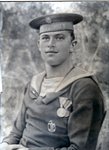
Note: Franz was being modest. For saving the U.XVI and the life of the stranded crewman, he was awarded the Bronze "Tapferkeit" medal for bravery at the risk of his own life.

The First Dive

The tenth day of February, 1916. Today, we had our first dive within the harbor. Right after breakfast the Torpedo Master took us aside and began in a solemn tone, "So that you know it, today we start with the diving practice. Be very careful that you don't do any foolish things. The Commanding Officer is going to run you through properly on the steering and on the valve stations. Show him that you learned and know something. Don't put me to shame."

"Torpedo Master, Sir!" I replied, "We are going to pull ourselves together."

At eight o'clock came the order. "All men on deck!" The Commander, Line ship Lieutenant Fandrich, Second Officer, Frigate Lieutenant Thot, Third Officer, Frigate Lieutenant Pospischil and Torpedo master Scholer. Then the torpedo instructors, Dzcmicek, Lehar, Ksoblar and Putigna. Also Machine Master Egger and Machine Mate Perno, Electro Master Brodinger, Electrician Gruner, Torpedo Foreman Stieber and...my humble self.

The Commander asked us a few questions first. Then the order sounded, "To the anchor station!" A couple of short commands, a few swiftly executed actions and the boat slid silently out of the cove. We headed first toward Castel Nuovo. You could hardly hear the exhaust of the diesel motor. A red signal flag was fastened to the periscope so the other ships could recognize that we are not an enemy ship when only the periscope shows. Then came the command, "Ready to dive!" All men had to go inside the boat and to their diving stations. Only the Commander remained yet on the tower. Not long before he too came down. Then it started. I was assigned to the valve station for venting operations. Then, "Dive tanks open!" it came down from the tower. The man at the dive tank valves turned the spindles around and I tore the vents open. The air hissed as it escaped out the vent pipes and the sea water gushed into the dive tanks.

The hands on the big depth manometer swung around and showed how rapidly the boat dived: 1-2-3-4-5-6-7-8-9-10 meters. "Dive tanks closed!" followed by, "Periscope up!" sounded from the tower. The dive tanks were closed and I closed the vent valves. The periscope whirred as it rose up. Now the boat was in a position where it could be kept constant only with the help of the regulator tanks. If it was too heavy, some water was pumped out. If it was too light, then some more water was allowed to flow in. The trim tanks and the depth-steering took care of balance. One of each was located fore and aft. The amount of water in them remained the same. They did not add more weight to the boat. The water was merely pumped from one to the other to lower the front or rear of the boat to facilitate the depth-steering.

For the two of us, one more thing to consider was the direction-steering. But that was no mystery since both of us did that on the torpedo boats. The reading of the gyroscope compass, with its division into degrees, was easier than the magnetic compass during calm seas. But in rough seas it could mean hell for the helmsman. This beast showed the tiniest deviation of the boat from course. When the boat was rolling and thumping, the needle danced around like crazy. If you got nervous, it would cause you a lot of pain and you wished this sensitive apparatus would go to the devil. There was also the magnetic compass onboard, but it never worked properly and no adjusting helped.

Stefan and I took all the instructions to heart and even studied in our free hours the duties we had to learn. Soon we could firmly master the procedures. We were ready to go into action with tense anticipation. We did not have to wait long to satisfy our wishes and it would require of us all possible efforts.

Tuesday, July 3, 2007

Onboard the S.M.S.U.B.XV Part 2


Yes, to be sure, the XV was small. It was one of the boats that Austria took over from Germany for coastal defense. 128 metric tons above water and 156 below. 28 meters long and 5 meters wide inside, in places only 1 1/2 meters. Two torpedo tubes that were already armed. The top speed was 5 miles on the surface and 4 miles under water. On deck, a 37 mm rapid-fire cannon and machine gun. Even though the crew was usually 20 men and 3 officers at the station, at sea there were only 3 officers with 13 men. That was all there was room for. Only 600 liters of water was taken along. That was for drinking and cooking. With the exception of the Commander, there was no washing, and even that you could not call washing. The bulk was tested for pressure up to 50 meters depth. A holding tank of 5000 lkg assisted surfacing if the boat should leak in the diving tanks. Besides that, there was a rescue bouy with telephone and light with 100 meters of cable attached to the boat which could be unbolted. If the boat could not surface despite the release of the holding tank, it could at least communicate with the upper world.

Every man had a life jacket that could be inflated and also served well as a pillow. The boat only had minimal speed but that disadvantage was partially balanced out by its ability to dive fast. The relatively limited range of operation could be somewhat increased by filling the trim tanks with fuel for the diesel engine. But that, in turn, decreased the diving capacity by making the boat lighter. Much to the detriment of the boat is the process of charging the batteries for the underwater running. There was only one motor available so the boat had to sit on the surface without any power for movement was at the mercy of the current. This is why the charging was done at night whenever possible.

For the improvement of the air, there was a ventilation system built in that included filter cartridges and oxygen supplement tanks that we carried with us. The inside of the boat was very cramped and the many wheels and levers made a confusing impression. It also meant that you had to be damned careful not to make the wrong move lest you could send the boat, with man and mouse, to the depths. That was enough reason to command a great respect for all the gadgets and we gladly submitted to the training with great pride.

During the following days we had torpedo maneuvers. This was for us quite an experience. How could we possibly move around in this 5 meter long and 45 centimeter thick heavy steel cigar? In this tight space where you could hardly turn around? But everything worked somehow since it was all measured out to the millimeter. The fact that we ended up with a few bumps did not matter and was taken as inevitable.

"What do you say? This is different than on the Budapest. There you could move around as you pleased but here you have to creep around like in a chimney." says Torpedo Instructor Lehar to us.

"Yeah, that's nice," we answer, " But in spite of that, it is here much more interesting for us. And here we know what we are doing it for. There it was only to keep busy smearing grease and polishing the aiming apparatus for nothing."

"Aye," he says, " We no not do nothing unnecessary here. But everything has to work efficiently, otherwise we might be out for some action and instead of accomplishing something, we have to be lucky that they do not rip off our behind!"